Why I Keep Talking About Swiss Cheese
One of the things I’ve learned on council is just how broad local government really is. In a single meeting, we might be discussing roads and utilities, housing, budgets, economic development, emergency services, healthcare advocacy, environmental issues, and community safety. Nobody around the table is an expert in all of those subjects, and I don’t think we’re expected to be. Our job is to listen, learn, ask good questions, and make informed decisions. That means drawing on the expertise of people who have dedicated their careers and lives to these areas. The more voices and expertise we can bring together, the better chance we have of understanding both the problem and the available solutions.
I’ve spent a lot of time thinking about homelessness, addiction, mental health, and community safety over the last four years. These aren’t simple issues, and I’ve found that the most meaningful progress usually comes from multiple approaches working together. My professional background has influenced how I think about these issues. In industry, risk management isn’t about finding one perfect solution. It’s about understanding the strengths and limitations of different controls and building systems where those layers work together.
Now please bear with me for a minute while I talk about Swiss cheese.
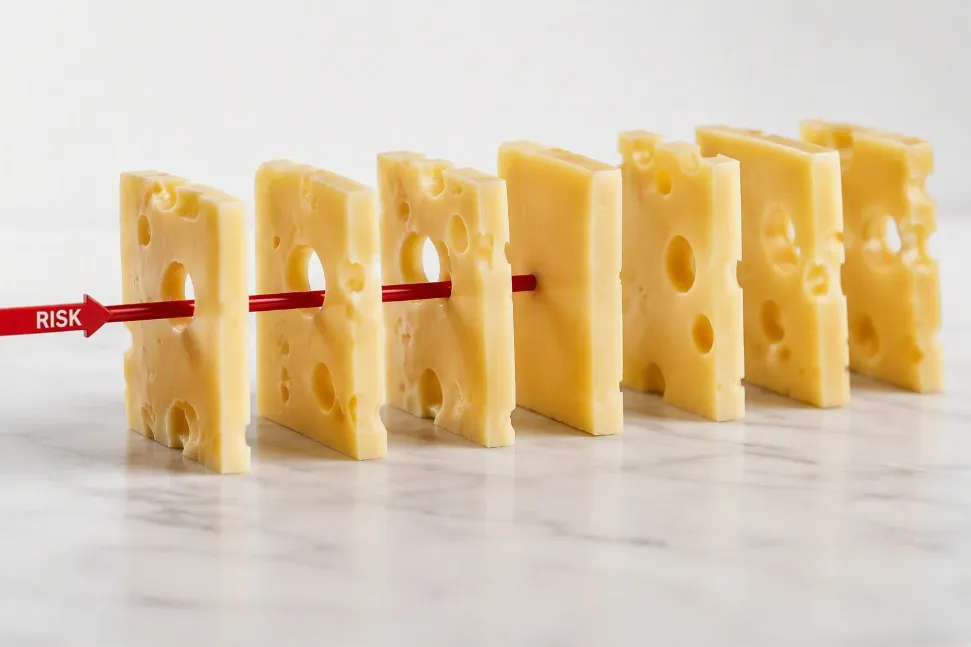
In the industrial world, the Swiss cheese model is based on the idea that every control, every safeguard, and every process has holes in it. Nothing is perfect. We know procedures won’t catch everything. Training won’t catch everything. Equipment won’t catch everything. So instead of relying on one thing, we build multiple layers of protection.
The goal isn’t to create a perfect slice of cheese. It’s to have enough slices that the holes don’t line up. I’ve found myself coming back to that concept when thinking about some of the challenges facing Trail. When I look at homelessness, addiction, mental health, and community safety, I see prevention as a layer. I see housing as a layer. I see harm reduction as a layer. I see treatment and recovery as layers. I see mental health supports as a layer. I see enforcement as a layer.
None of them are perfect, and none of them are enough on their own. Prevention, housing, treatment, recovery, enforcement, and harm reduction all serve different purposes and reach people at different points in their lives. Each helps fill gaps that another layer may miss and each one becomes more effective when the other layers are there too.
The question isn’t whether any single layer has holes. Every layer has holes. The question is whether we are building a system with enough layers that people are less likely to fall through the gaps. That’s why I sometimes get concerned when our conversations focus on the shortcomings of individual approaches rather than the gaps that still exist in the overall system. I’d rather see our community united around advocating for more slices of cheese.
It’s also important to make sure that the layers we do have in place are working together effectively. That’s why I’ve been interested in bringing a Situation Table to Trail. For those unfamiliar with the concept, a Situation Table brings together organizations such as healthcare providers, social service agencies, schools, outreach workers, police, and others when someone is facing an acutely elevated risk situation. The goal isn’t to create another agency or another layer of bureaucracy. The goal is to connect organizations that already exist so supports can be coordinated before a situation becomes a crisis.
A healthcare worker may see one piece of the puzzle. A teacher may see another. A social worker may see another. A police officer may see another. Individually, they each have valuable information. Together, they have a much better chance of identifying risks and connecting someone with the support they need.
Progress comes from bringing together expertise, perspectives, services, and supports in ways that make the whole system stronger. As a Councillor, that is the role I try to play. Not the expert on every issue that comes before council, but someone who listens, learns, creates space for different voices, and helps connect people and ideas.
Because when we bring the right people together and focus on filling the gaps instead of fighting over the pieces, we have a much better chance of making progress. Sometimes that means advocating for another slice of cheese. Sometimes it means helping the slices we already have work better together. Either way, it’s about building a stronger community.